Investir à Marrakech : Le Guide Complet pour l'Investisseur Étranger Francophone
Acheter une Villa à Marrakech

Marrakech Medina: Living in the Old City — Riads Guide
The medina of Marrakech is one of the best-preserved old cities in the Arab world. Listed as a UNESCO World Heritage Site since 1985, it captivates with its labyrinthine alleyways, colourful souks, lively squares and, above all, its Marrakech riads — traditional homes centred around an interior garden that form the architectural soul of the ochre city.
Living in the medina of Marrakech means choosing an extraordinary experience: waking to the call of the muezzins, wandering through thousand-year-old derbs, catching the scent of spices from the souk at every turn. For many foreign investors and members of the Moroccan diaspora, it also means seizing a unique property opportunity in a neighbourhood whose authenticity is irreplaceable.
This guide walks you through everything you need to know to understand, live in and invest in Marrakech medina riads: property characteristics, buying process, legal specificities, renovation, rental potential and current prices. With Celestia Invest, find the riad that matches your lifestyle or investment project.
Table of Contents
- Marrakech Medina: History and Unique Character
- Riad Architecture: The Art of Turning Inward
- The Medina Neighbourhoods You Need to Know
- Daily Life in the Medina
- Buying a Riad in the Medina: Process and Specificities
- Legal Aspects: Melkia, Title Deed and Key Checks
- Renovating a Riad: Challenges and Opportunities
- Rental Potential and Tourist Accommodation Standards
- Riad Prices in the Marrakech Medina
- Tips for a Successful Riad Purchase in the Medina
Marrakech Medina: History and Unique Character
Founded in 1070 by the Almoravids, Marrakech is one of Morocco's four imperial cities. Its medina, covering more than six hundred hectares, is still home to over 300,000 residents and stands as one of the most vibrant historic urban centres in the Mediterranean basin.
What sets the medina of Marrakech apart from all other old cities is the intensity of its social and commercial life. The souks are organised by trade — copper, leather, spices, rugs, wood — the fondouks have sheltered craftsmen and merchants for centuries, and the Jemaa el-Fna square remains the beating heart of an animation that never truly stops.
For the property investor, this singularity is a major asset. Marrakech medina riads represent a niche market with strong heritage value, where supply is structurally limited by architectural conservation constraints and the impossibility of new construction. It is precisely this scarcity that underpins prices and ensures exceptionally robust tourist rental demand.
Riad Architecture: The Art of Turning Inward
A Marrakech riad is a traditional house built around a central patio adorned with a garden — the Arabic word "riad" means "garden". This introverted architecture is an ingenious response to the Marrakech climate: thick pisé walls keep the interior cool in summer, the patio creates natural ventilation, and fountains provide welcome humidity.
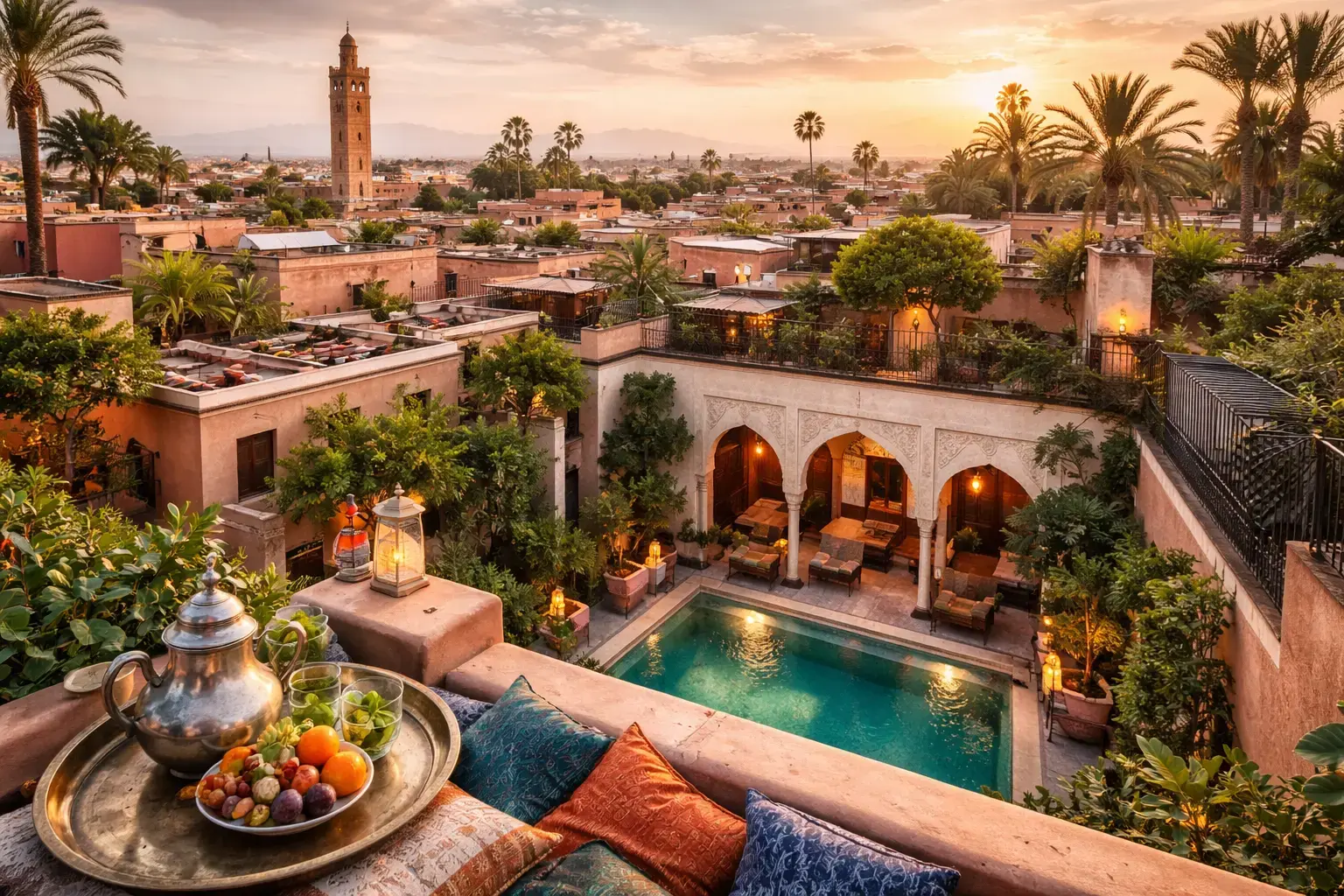
The spatial layout of a riad follows precise rules. The ground floor houses the reception rooms and salons — the famous "maâziba" — opening onto the patio. The upper floors contain the bedrooms. The rooftop terrace is often the most prized living space: it offers a sweeping view over the city's pink rooftops and the minarets that punctuate the medina skyline.
The characteristic decorative elements of a traditional riad are zellij (glazed ceramic tilework), tadelakt (polished lime plaster), carved wooden moucharabiehs, sculpted plasterwork and horseshoe arches. These unique artisanal details form both the property's identity and its premium commercial appeal to a demanding international clientele.
Riads are classified into several categories by size and configuration. Small riads — between 80 and 200 m² — are perfect for a private residence or a charming guesthouse with four to six rooms. Medium-sized riads, between 200 and 500 m², lend themselves to a more structured guesthouse operation. Large riads and palaces sometimes exceed 1,000 m² and can accommodate a full hotel operation.
For a complete guide on acquiring a prestigious riad, consult our article ultimate guide to buying a luxury riad in Marrakech.
The Medina Neighbourhoods You Need to Know
The medina of Marrakech is not a homogeneous space. It is made up of several distinct neighbourhoods, each offering a different living environment and investment potential.
The Kasbah and the Mellah
The Kasbah, the ancient royal citadel, is one of the most sought-after neighbourhoods for riad acquisition. It is home to the magnificent Kasbah Mosque and benefits from particularly well-preserved architecture. The Mellah, the historic Jewish quarter adjacent to it, has experienced a renewed surge of interest in recent years, with properties still accessible but rising strongly in value.
Bab Doukkala and Bab El Khemis
These neighbourhoods in the northern medina are less touristy and offer a more authentic living environment, appreciated by residents who wish to immerse themselves in local life. Prices are even more competitive here, with interesting capital gain potential as demand spreads.
Dar el Bacha and Mouassine
The Dar el Bacha neighbourhood, centred around the eponymous palace, is one of the most sought-after in the medina. It combines proximity to the souks, the relative calm of residential derbs and architectural beauty. The Mouassine area, with its fountains and craftsmen, attracts a high-end investor clientele.
Around Jemaa el-Fna Square
Riads close to Jemaa el-Fna enjoy an exceptional location for tourist rentals, with maximum accessibility for visitors. The trade-off: prices are higher and evening activity can be present.
Consult our analysis of the best neighbourhoods in Marrakech for investment to refine your geographic choice.
Daily Life in the Medina
Living in the medina of Marrakech is an incomparable sensory and human experience, but it demands an adjustment that every prospective resident must anticipate.
Accessibility and Traffic
The medina's derbs are, by definition, inaccessible to vehicles. Deliveries are made by mule or carried by hand from the medina gates. You should therefore plan for parking near the ramparts if you own a car. In return, this absence of motor traffic gives the medina's residential neighbourhoods absolute tranquillity — children play safely in the alleyways, and the pace of life is profoundly peaceful.
Amenities and Services
The medina has all essential services: neighbourhood hammams, grocery shops, traditional bakeries, doctors and pharmacies. Supermarkets and modern clinics are found in Guéliz, accessible in a few minutes by taxi or carriage. International schools are also located in the modern neighbourhoods, which is a point to consider for families with children.
Community and Integration
The medina is a strong communal living environment. Neighbourly relations are important, and foreign residents who take the time to learn a few words of Moroccan Arabic and respect local customs generally integrate very well. This human dimension is often cited by expatriates as one of the main reasons for their deep attachment to the medina.
Buying a Riad in the Medina: Process and Specificities
Buying a riad in the Marrakech medina follows the broad lines of the Moroccan property process, while presenting specificities unique to this type of property and this historic neighbourhood.
Search and Selection
Not all riads for sale are visible online. A significant share of transactions takes place through local networks and specialist estate agencies present in the medina. Relying on a trusted partner like Celestia Invest is essential to access the full range of market opportunities, including those that never appear in public listings.
Viewing and Due Diligence
Visiting a riad requires particular attention to several points: the structural condition (walls, roof, terrace), electrical and plumbing installations, the presence of damp or saltpetre in the thick walls, and the condition of the decorative elements (zellij, plasterwork, wood). A technical survey by an architect specialising in heritage restoration is strongly recommended before any commitment.
Negotiation and Sale Agreement
Once the property is selected, negotiation can begin. Listed prices in the medina are often negotiable, particularly for properties requiring significant works. Signing a sale agreement before a notary sets the terms of the transaction — price, timeline, any suspensive conditions. To understand the key clauses, consult our article on suspensive conditions in a Moroccan sale agreement.
Final Signing at the Notary
The final sale is completed at the notary, who proceeds with the property transfer and registration. For a complete overview of the process, consult our detailed guide on the property buying process in Morocco.
Legal Aspects: Melkia, Title Deed and Key Checks
One of the most specific aspects of buying property in the Marrakech medina concerns the legal status of the properties. Unlike modern neighbourhoods where the vast majority of properties are registered in the land registry with a clear title deed, a significant portion of medina riads are still held under melkia.
What is Melkia?
Melkia is a traditional Moroccan form of ownership based on authentic deeds drawn up by adouls (traditional notaries) rather than a modern title deed. This type of ownership can be perfectly valid legally, but it presents specific complexities: joint ownership among multiple heirs, a chain of title that can be difficult to reconstruct, and the risk of late claims.
For foreign buyers in particular, it is imperative to carefully verify the legal status of the property before any signing. An experienced notary familiar with medina transactions is essential. Our complete guide on melkia in Morocco explains in detail the checks to carry out.
Land Registration: A Recommended Step
It is strongly advisable, when purchasing in the medina, to proceed with the registration of the property in the land registry if this has not yet been done. This procedure, carried out by the notary with the assistance of a surveyor, permanently secures ownership and facilitates any future resale or transfer.
Acquisition Costs to Anticipate
As with any property purchase in Morocco, costs are added to the sale price: registration duties (4%), notary and land conservation fees (1.5 to 2%), agency commission and any registration fees. To avoid surprises, consult our article on the hidden costs of buying property in Marrakech.
Renovating a Riad: Challenges and Opportunities
The vast majority of riads available for purchase in the Marrakech medina require works, ranging from simple cosmetic refreshment to the complete renovation of a property in ruins. Renovating a riad is both a logistical challenge and a creative and financial opportunity.
Architectural Constraints
Since the medina is a UNESCO World Heritage Site, renovation works are subject to approval from the relevant authorities, notably the Regional Directorate of Culture and the municipality's urban planning department. Modifying the exterior facades facing the street or raising buildings beyond existing height limits is prohibited. However, interior layouts offer great freedom, provided that listed architectural elements are preserved.
Construction Logistics in the Medina
The absence of vehicle access imposes significant logistical constraints. Building materials are transported by mule or carried by hand from access points in the ramparts. This implies longer timelines and higher costs than a construction site in a modern area. It is essential to work with craftsmen and project managers experienced in medinal heritage restoration.
Appreciation Potential
A well-executed riad renovation is one of the most profitable property operations in Marrakech. A riad acquired in raw condition for €200,000 and renovated for an additional €150,000 can be worth €600,000 to €800,000 once transformed into an operational charming guesthouse. This considerable added value attracts many investors seeking a high value-added project. For inspiration, consult our guide on renovating and modernising a historic property in Marrakech.
Rental Potential and Tourist Accommodation Standards
A riad in the Marrakech medina is one of the most sought-after products on global tourist rental platforms. Airbnb, Booking, Mr&Mrs Smith and specialist luxury rental agencies list hundreds of riads by the night, week or month. International demand is exceptionally strong throughout the year.
Rental Yields
A well-renovated charming riad with four to six rooms can generate between 150,000 MAD and 400,000 MAD in gross annual turnover, depending on its positioning, décor and management quality. Occupancy rates reach 70 to 85% in high season (October to April) and hold reasonably in summer thanks to Middle Eastern clientele. Gross yield generally ranges from 6 to 10% depending on the acquisition price and service level.
New 2024 Classification Standards
Since decree 985-24 of 24 December 2024, Morocco has thoroughly reformed its tourist establishment classification system. For riad-guesthouses, the new regulations impose mandatory standards (A standards): en-suite rooms, breakfast included, welcome products, strict cleanliness and basic security. Complementary standards (B standards) reward service quality: authentic décor, traditional meals, cultural activities, multilingual website, online booking.
This regulatory upgrade is an opportunity for quality riad owners: it creates clear differentiation from non-compliant establishments and strengthens the attractiveness of well-managed riads to a demanding international clientele. To fully leverage this potential, discover how to manage your Marrakech rental property without hassle and our advice on short-term rental strategies in Marrakech.
Delegated Rental Management
For non-resident owners — who make up the majority of medina riad buyers — delegating rental management to a specialist agency is the optimal solution. A good agency handles bookings, guest welcome, daily maintenance, supplier management and rental accounting. It allows you to maximise income while freeing you from all operational constraints.
Riad Prices in the Marrakech Medina
The Marrakech medina riads market is a niche market with wide price disparities depending on the property's condition, size, location and renovation level.
Riads in raw condition or requiring complete renovation are generally negotiated between €100,000 and €300,000, depending on size and location quality. These properties represent opportunities for investors with an appetite for transformation projects.
Partially renovated riads or those in good general condition are priced between €250,000 and €600,000. They allow relatively swift activation as tourist rentals with a limited additional investment.
Fully renovated riads with high-end finishes, restored original zellij, compliant plumbing and electrics are priced between €500,000 and €1,500,000. Exceptional palaces and grand riads can exceed €2,000,000.
In 2026, riad prices in the Marrakech medina are recording annual growth of around 5 to 8%, driven by growing demand from European, American and Middle Eastern buyers. Quality supply remains scarce and moves quickly. For a detailed analysis of price trends, consult our guide on Marrakech property prices.
Tips for a Successful Riad Purchase in the Marrakech Medina
Investing in a riad in the Marrakech medina is an extraordinary adventure, provided you approach the project with method and expert support.
Define Your Project Clearly
Personal residence, guesthouse to operate, or mixed personal and rental use? The project determines the selection criteria: minimum floor area, number of rooms, location relative to the souks and circulation routes, acceptable renovation level. Take time to define your requirements precisely before beginning viewings.
Surround Yourself with the Right Experts
Buying a riad in the medina involves several experts: an estate agent specialising in medina properties, a notary mastering the subtleties of traditional Moroccan ownership, an architect specialising in heritage restoration to assess the works required, and possibly a lawyer for complex cases. Celestia Invest can direct you to the most appropriate professionals for each stage of your project.
Scrupulously Verify the Legal Status
This is THE non-negotiable point. Before any signing, have the following checked: the title deed or melkia deeds, the existence of potential co-owners, the absence of easements or disputes, and the property's tax situation. For foreign buyers, consult our guide on how to become a property owner in Morocco as a foreigner.
Budget Renovation Works Realistically
The cost of renovating a medina riad must be estimated precisely and increased by a contingency reserve of 20 to 30% for unforeseen issues — very common in old buildings. An underestimated works budget is one of the main sources of disappointment for riad buyers. Have a detailed quote drawn up by an architect before finalising the purchase price.
Explore the Riads Available at Celestia Invest
Celestia Invest holds a portfolio of selected riads in the Marrakech medina for different investor profiles. Browse our listings to discover properties such as Riad Soleil, Riad Salama, Riad Ismail, Riad Satin and Riad Qamar. Each property is presented with a detailed description, photos and essential information to help you identify the opportunities best suited to your project.
Browse our full selection of properties in the Marrakech medina and discover our complete guide to property investment in Morocco for an overview of the market.
Conclusion: The Marrakech Medina, an Investment of Heart and Mind
Acquiring a riad in the Marrakech medina is far more than an ordinary property investment. It is anchoring yourself in a thousand-year heritage, contributing to the preservation of an architecture unique in the world, and joining a community of admirers of the ochre city spread across the globe.
Marrakech medina riads today represent a niche market with strong potential: scarce quality supply, solid tourist rental demand, steady price appreciation and an irreplaceable cachet that attracts the most discerning travellers. Well prepared, surrounded by the right experts and supported by a specialist agency, your medina riad project can combine the pleasure of living with investment performance.
Contact Celestia Invest for a personalised consultation and let us guide you to the riad that matches your vision — whether it is a peaceful haven for you and your family, or a charming guesthouse with solid returns.

Related Posts
News insight

What does this mean for your project?
Tell us what you are looking for. We will help you identify the properties and the next steps that suit your plans.
Discuss your search